

Why Slow Travel is the Best Way to Experience Regional Destinations
Why Slow Travel is the Best Way to Experience Regional Destinations
Quick and hectic vacations in checklist style generally make people feel more exhausted compared to before the vacation started. Slow travel doesn’t solve this problem by offering less to do, but it rather provides a deeper experience in exchange for less superficial exposure and a more relaxing experience overall.
What Slow Travel Actually Means
Slow travel wasn’t born out of the vacation industry. It adopted the reasoning from the Slow Food movement, which countered fast food culture by explaining that the preparation and enjoyment of a meal are equally important to the meal itself. The same goes for traveling. The journey, the destination, the people you encounter along the way, these are not just interval inconveniences between two sights. They are the essence of travel.
In simple words, slow travel is about choosing a particular region and staying there long enough so you can truly get to know the area. Instead of visiting six cities within ten days, you should rather spend ten days in a valley, a coastline, or a wine region. Visit the same market twice. Find where the locals are having breakfast. Discover that the next town has a Tuesday night concert series that no tourist publication publishes anywhere.
Tourism based on a checklist aims for variety. Slow travel aims for experience. It is not just two different tastes, it’s two different types of traveling.
What Ground Transport Gives You That Flying Doesn’t
There are good reasons why getting from A to B by road is at the heart of slow travel philosophy, and it goes beyond pound-for-pound CO2 emissions. Fly, and you effectively bypass the land. You leave one airport-forced-circulation bubble, to parachute into another at the other end. The geography in between is never part of the deal.
Take coach or train travel through a wine region, along a river valley or between one long, drawn-out piece of coastline and another, and the land is the main course. You see the levels of the land change, the land-use alter: orchards become vineyards, towns become villages, the light deepen and grade as upland turns to mountains; that gradual change is, in part, why you are there. It is part of the information you are ingesting.
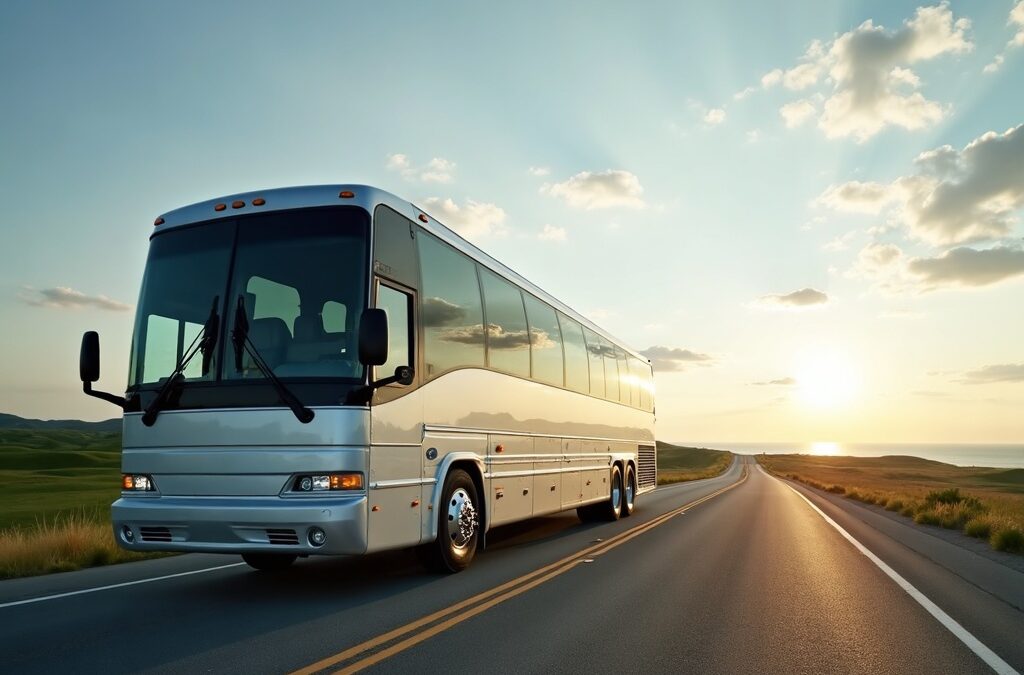
Then there is the group experience. For groups traveling through regional areas, a charter bus solves a problem that independently rented cars create: fragmentation. When a group of 15 splits into four vehicles, you’re not traveling together anymore. Someone takes a wrong turn. Another car pulls off to stop somewhere the rest of the group missed. By the time everyone arrives, the shared experience has been diluted. A single coach keeps the group intact, removes the stress of navigating unfamiliar rural roads, and cuts the carbon footprint of the trip significantly compared to multiple individual vehicles.
The Problem With Moving Too Fast
Feeling burned out from following such a hectic agenda is a common experience, but surprisingly, itinerary fatigue is rarely mentioned. This is what you perceive after that kind of vacation: you probably needed another few days off to rest from your vacation. Sounds absurd? That’s because you’re living at breakneck speed. Give it a bit of thought, it’s crazy.
It’s a vicious cycle: the frantic motion keeps you from enjoying the places you are in, because you’re always busy organizing things, getting there, reserving something else, packing, heading to the station, the airport, the bus stop. Real breaks are as scheduled as a sudoku game. And so you need ever more traveling, to recuperate from your traveling.
And you never get to know the pleasure of knowing a city or a region, that exhilarating feeling that you live somewhere different from home, and it’s not as hard as you had thought. Slow travel creates space for the unexpected. An afternoon that wasn’t planned. A conversation that runs long. A detour that turns into the highlight of the whole trip. None of that happens when you’re scheduled to the hour.
Regional Destinations Don’t Work at High Speed
Here’s the thing about places like Oregon’s wine country, the Hudson Valley, or the coastal stretches that don’t appear in "top 10" destination lists: they weren’t designed for fast consumption. Their value is cumulative. You don’t understand a regional food culture by eating one meal. You don’t grasp the rhythm of a farming community by driving through it. You don’t appreciate the way light hits a particular valley at 6am unless you’ve been there long enough to be awake for it.
Regional destinations are structurally incompatible with checklist travel. The things that make them worth visiting, the micro-breweries, the farm stands, the single-road drives through orchards, the festivals that happen once a season, require time and proximity to access. A traveler passing through for 18 hours will miss nearly all of it, not because they’re careless but because there literally isn’t enough time to find any of it.
Micro-tourism and under-tourism thrive here. These are regions that genuinely benefit from visitors who stay, spend, and engage. They don’t benefit from people who drive through and post a photo.
The Economic Case For Staying Longer
When you stay in a regional area for a week or more, the destination of your dollar changes. Rather than heading into chain hotels and airport restaurants, it’s going towards family-owned bed and breakfasts, regional artisans, local farmers’ market sellers, and independent tour guides who’ve been part of the community their entire lives.
This is what economists refer to as the local economy multiplier effect. Money spent within an independent regional business is more likely to recirculate within that community, the innkeeper pays the local cleaner, who buys their groceries at the local market, that sources their produce from the local farm. That chain doesn’t happen when you book a branded hotel and eat at a chain restaurant that ships profits out of town.
76% of global travelers say they want to travel more sustainably, and 43% actively want to support local economies by choosing off-the-beaten-path regional destinations to help reduce the strain of over tourism (Booking.com Sustainable Travel Report).
The desire is there. Slow travel is the mechanism that makes it real. You can’t meaningfully support a local economy from a 20-hour visit. A week-long stay is a different story entirely.
How the Hub-and-Spoke Model Works
The most manageable and rewarding form of slow regional travel is a hub-and-spoke structure, and once you’ve tried it, it’s hard to see why you’d ever do it differently. Instead of plotting a new base on the map for each night, you plant a single base in the same wider region for a week (or preferably more), and make day trips outward in every direction.
The hub provides the routine. You unload your clothes and supplies and settle in. By morning two, you have perhaps located the best bakery or coffee roaster in town. By day three, you’re starting to recognize faces around the neighborhood. By day four, you overhear a conversation and recognize a name: you’re not entirely sure yet but you think you know the face too.
The spokes provide the adventure. Each day, you set out for a different border of the region, a different viewpoint or round point, a different mountain crease. You know you are returning somewhere familiar by early evening.
Multi-stop trips ruin the experience of travel by keeping the worst bits (packing, checking in and out, detachment) and lose the unparalleled joys of being somewhere new: of waking up knowing you have no idea what you are going to find. A week based in one spot and six or seven spokes arriving home covers more emotional ground than a fortnight racing to arrive and leave different cities.
Building Authentic Local Connections
One of the advantages of slow travel that people usually don’t talk about is the social aspect when you stay somewhere for long enough to become a minor regular. The traveler-local relationship changes.
Locals can differentiate between someone who’s just passing through and someone who’s been around for a couple of days. The second type gets spoken to slightly differently, not better, necessarily, but more openly. Conversations go a bit deeper. Restaurant owners pull no punches. A shopkeeper brings up a trail that doesn’t seem to have any posted trailhead. An innkeeper mentions her cousin who does private wine tastings on a property that has never appeared on any tour.
This is cultural exchange in its authentic form, the kind that few tourists (with their itineraries full of obligatory box-checking) will ever experience. It requires time, repeat presence, and the willingness to talk not just to the people who sell to tourists but to those who will never sell anything to visitors. Spend a week in a regional community and you may become used to daily life as lived by local people, market days, trash day, the fact a bus stops here at 11 and another at 2 but nobody’s always completely sure about times so you see the occasional straggler running to catch it in a cloud of dust.
Going Deeper Through Food
Regional food culture provides one of the simplest, purest connections to place, and it takes less time than you might think to get past the pretense and to the essence. Slow travel allows for a full arc of culinary regionalism: visiting the farmers’ market early in the week to understand what’s actually in season, eating at restaurants using those same ingredients, visiting the vineyard where the wine was made, talking to the cheesemaker at the Saturday market. These experiences connect to each other and to the land they came from. The food stops being background and becomes context.
This kind of depth isn’t a luxury reserved for dedicated food travelers. It’s available to anyone who spends more than a few days in a single regional area with a loose enough schedule to follow curiosity wherever it leads.
Reclaiming the Joy of Going Somewhere
The most compelling reason to travel slowly is not environmental, or economic, or cultural although it is all of those things. The best reason is that it just feels like a holiday once you get home again.
And when you return from a place you spent a week in and got to know, a little at least, there’s a specific pleasure in homecoming. You remember specific faces, specific tastes, specific silences. You remember a place you’d like to return to. This is the difference between sight and experience, and slow travel is the surest approach from the first to the second.